
The Gregory Awards and Why Acknowledgment Matters
Written by TeenTix Newsroom Writer SAGE LANG-WOODWARD
Interview with BARBARA CALLANDER arranged by Theatre Puget Sound
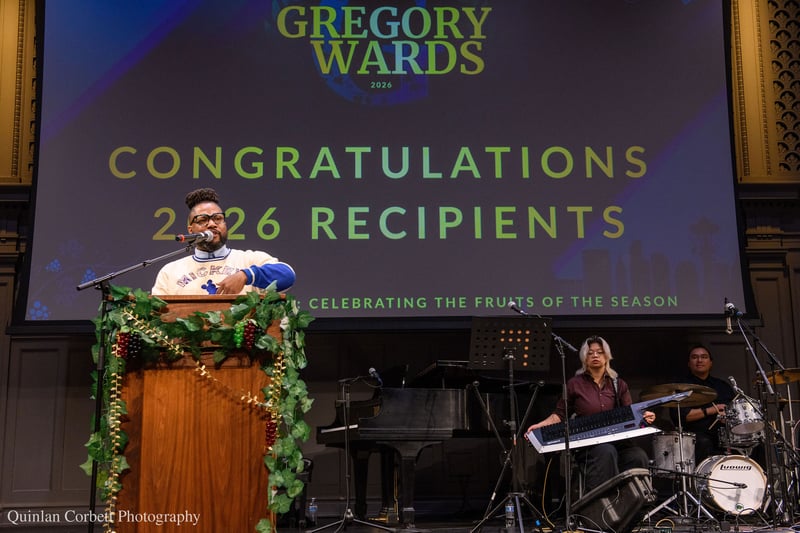
Theater Puget Sound has presented The Gregory Awards since 1998, in memory of lifelong northwest theater pioneer Gregory A. Falls. Despite being put against the herculean trials of having to rebuild after the pandemic, TPS has managed to put together their third in person celebration since their COVID-19 hiatus. This year’s theme was ‘A Grand Bacchanal.’ The word ‘bacchanal’ comes from the Roman name for Dionysis, the god of wine and celebration. While Bacchus is known as the god of overindulgence; can one overindulge on community? Seattle’s unique atmosphere for those who are a little strange and have a deep love of what they care about fosters a connection that makes people glow. Walking around the room, one would know immediately that the Gregory Awards are more than your typical award show. They’re representative of what kind of community Seattle has built already and the one its artists continue building.
Many of the awards presented are ones valuing community interaction and helping to make the theater scene in Seattle a better place. This includes the newest addition to the awards this year, the Barbara Callander Award For Solidarity and Activism, named for its inaugural recipient. Barbara Callander is the current Vice Chair for Theater Puget Sound’s Board of Directors, and served as a founding board member for the company in the 1990s. She has been a key part of the theater community in the larger Seattle area for decades, and has more than earned the title of this award. I got the amazing opportunity to speak with her about her career, the award, and the future of arts advocacy.
Sage Lang-Woodward: How did you get into working with the arts?
Barbara Callander: The beginning of my involvement in the arts is when I was a kid. In elementary school I wrote plays so I could be in them. I was in a dance company during my middle and high school days, and we did original children’s ballets. Our music director was a woman who was a violinist with the National Symphony in D.C, which is where I grew up. Then, when I went to college, I slipped into theater without intending to. I spent the first half of my senior year doing an internship at a regional theater in the D.C area called Arena Stage. (...) [it was] like Seattle Rep or what is now known as Union Arts Center, that level of theater. I came back to D.C after graduating from college and started my career there, then I moved to New York, and then I moved to the Seattle Area.
SLW: What’s your history with TPS?
BC: I got involved with Actors Equity, the union, out here almost immediately. Then a couple years later, when a group of people started talking about starting a theater support organization, I was invited to be a part of that. Out of that grew Theater Puget Sound. So I was a founding board member, then in the early 2000s I was off the board for a while because I went back East, starting to go back and forth across the country. Then recently I rejoined the board, and I am one of the few people with the memories of what’s happened in the past.
SLW: Why does this award and acknowledging advocacy in theater matter?
BC: I did not know it was coming! I’m so incredibly grateful for the award, and I think it does reflect the things I have done and also the general feeling in this community that we all need each other for the theater community to survive and thrive. I’m sure you know what Greg Falls said when he was starting ACT, “Theaters are like grapes, they grow best in bunches.” That has been the byword for the community here ever since he did that back in the 60s. It ebbs and flows, there are some new people in town. I think the award was given to me because solidarity and activism is a big thing in the union community as well, and I am both [of those things.] I try to work in our arts community, and I am also on the board for the governing body for the actors union. I try to work with everyone. That doesn’t mean I always agree with everyone, I often don’t agree. But it’s important to work together to find solutions that will benefit the most number of people.
SLW: In your speech you said that this award “comes at a time where we need to fight not just for our community, but for the world?” How are those two things connected (our community, the world) and how can we advocate and fight? Why does it matter?
BC: Well between us and the world is also our country. I received that award and made the speech before the midterm election. The arts have suffered dramatically in recent years, part of it was the pandemic, but a lot of it has to do with the position that people in power have taken. I grew up in the D.C area where the Kennedy Center is. I worked near it. I think it is important at all levels for people to find “win-win” solutions to problems. That’s the stance, for the most part, our community takes, and it’s certainly a stance I try to take. In founding Theater Puget Sound, we did something unusual. We set out, and have been successful, in creating an organization that serves individuals (union, nonunion, to completely unprofessional) as well as serving theaters as well. The theaters in this town feel like they need each other, from the smallest fringe community theater to the biggest theaters.
SLW: As someone who went last year, I definitely see that especially at the Gregory Awards and the changes made (ex. How they split certain awards) feels like they want to showcase art at all levels. Do you think that the acknowledgment of smaller theaters is part of the advocacy for theater?
BC: I’ll briefly address my award. The things that award is acknowledging are how I believe I’ve operated for quite a while now. This is now a third award like the Greg Falls Award (lifetime achievement) and the Melissa Heins award (behind the scenes.) With the other changes, we expanded a couple for productions where we split them into level one and level two, correlating with the size of the theater and budget. This was a good step, and I believe there will be changes and additions as we move down the road. We’ve also been working on expanding the scope of Theater Puget Sound geographically. Now that we have things like Zoom, people are able to participate more in committees. I mean just two years ago we held it at the Center Theater where we had to circle people in and out to give them the awards! We’re making major steps forward. The board and staff are interested in getting more people involved to learn how we can improve.
SLW: What advice would you give to young advocates?
BC: It’s never too soon to get kids involved in seeing and doing theater. For example, Seattle Children’s Theater and other places have a lot of training programs. Speaking of them, I was seeing a show with them recently and there was a woman with a four month old baby with her. I don’t know how much the baby appreciated it *laughs.* But that’s why Seattle Children’s Theater is such an amazing place, they are dedicated to doing children’s theater that doesn’t talk down to children. Get involved in programs connected with theater. I would love to see more programs aimed at younger advocates with TPS. One of the things we are trying to do is serve, and we need more input on how to serve different audiences. So I’d encourage any young people to reach out and get involved. Let us know what they’d like to see.
SLW: When we are in a crisis, it’s easy to lose sight of why creativity matters. Why does it matter that we keep supporting the arts if bad things are happening in the world?
BC: In terms of creativity, it’s important to help keep us sane. The arts are tied in with all sorts of other things. You don’t have to be a professional artist to appreciate and benefit from the arts. Music is tied in with mathematics; there are connections there. Sometimes the arts are a way to reach people who are having various kinds of problems. The arts are used as therapy. The other reason I think the arts are important, particularly the performing arts, is that they help support the greater economy. If someone goes to a theater production: they are buying tickets, if they have kids they are either bringing them or hiring someone to look after them, maybe they’re going to a restaurant to eat. All of that supports the greater community, not just the arts. When we had to roll up all the artistic sidewalks during the pandemic, it didn’t just affect the arts. It affected the community.
Lead photo by Quinlan Corbett.
This article was written on special assignment through the TeenTix Press Corps. The TeenTix Press Corps promotes critical thinking, communication, and information literacy through criticism and journalism practice for teens. For more information about the Press Corps program see HERE.
