
Spectrum’s "Insidious Trilogy" Confronts the Legacy of Jim Crow
Review of Insidious Trilogy at Spectrum Dance Theatre
Written by TeenTix Newsroom Writer STEPHEN ZHOU
Edited by Teen Editorial Staff Member THIEN-NHI NGUYEN
Jim Crow is often seen as a distant evil completely removed from modern society. Many Americans know that the Civil Rights Act was passed in 1964. Fewer realize how close 1964 is to the present day – just over 60 years. The generations who lived through segregation are still alive today: baby boomers were born just before the era of segregation came to a close. And beyond Jim Crow, other forms of systemic racism, such as redlining and its lasting effects, persisted long after segregation ended. Donald Byrd’s dance performance, the Insidious Trilogy at the Spectrum Dance Theatre, confronts our nation’s legacy of racism by tracing its progression through history.
The dance performance was broken into three acts: Strange Fruit, Targeted, and Grief. The acts differed in theme and style, but all shared a sorrowful mood, fitting the tragic events depicted.
The title of the first act, “Strange Fruit” is a reference to the 1937 Billie Holiday song. The “strange fruit” references the bodies of Black lynching victims hanging from trees, serving as a powerful condemnation of racial violence in the United States. Reflecting this imagery and message, a black tree lies ominously in the center of the stage, along with a Black man and woman. This image resembles the historical photographs of lynchings after the Reconstruction era, immediately connecting the song and the act. To their sides await the ensemble, consisting of faceless men and women wearing white cloth masks. The white hoods evoke the image of the KKK, a white supremacist terrorist group formed to rollback Reconstruction. Their facelessness makes the ensemble feel more a force of nature than individuals as they mechanically march, jump, and shout in unison. As they do so, the Black people in the center cower in fear. Their anxieties are proven right as the men of the ensemble attack the Black man and woman, and binds and marches them to the center of the stage on the shoulders of the men. She Who Sees, a central female figure who represents the community affected by lynching, is stabbed and falls to the ground. The perpetrators throw down the man and woman to their death, leaving the audience in shock. The act ends with She Who Sees’ getting back up to weep over the bodies of the deceased, reminding the audience that the impact of racially motivated violence is wider than just the victims.
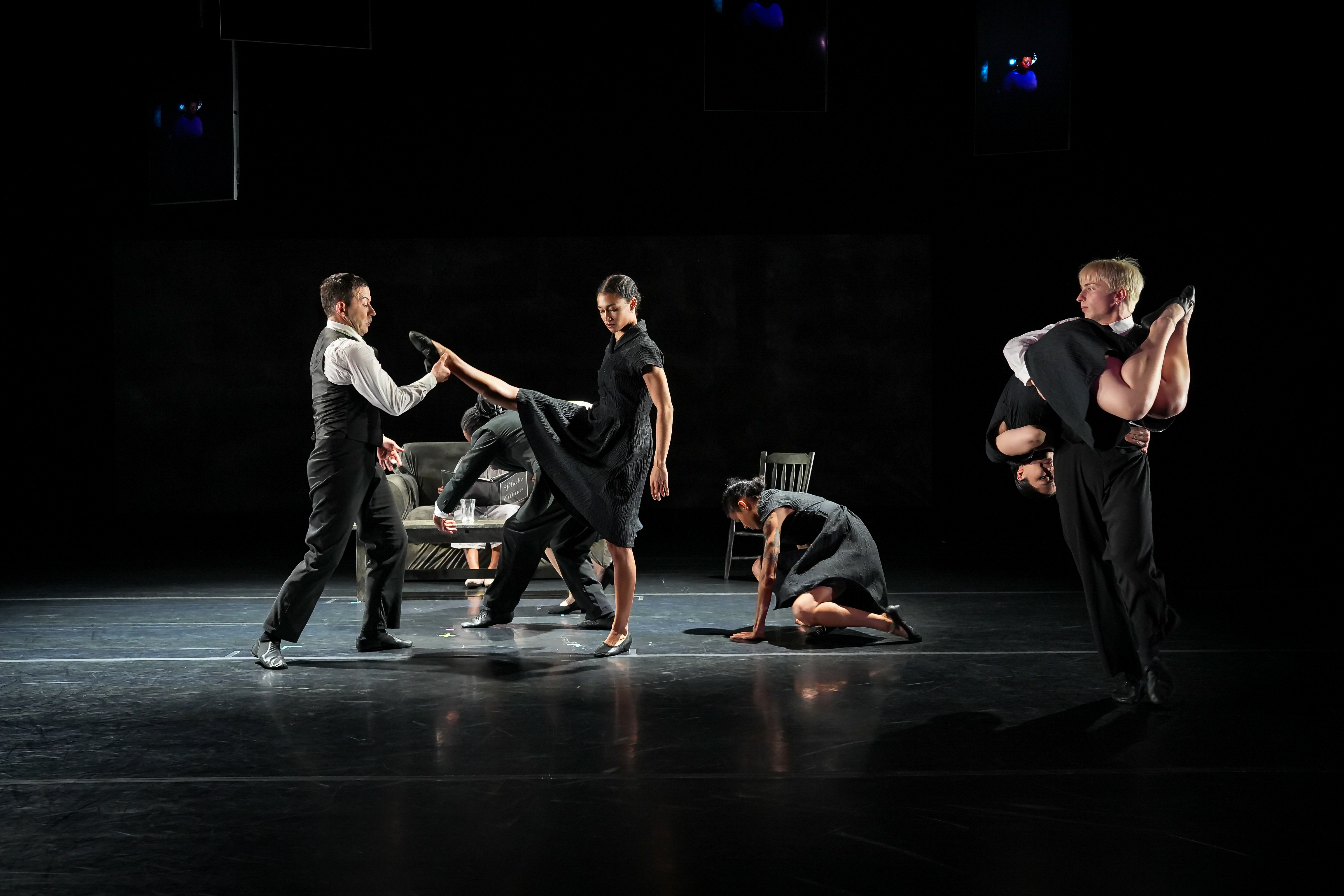
The second act, Targeted, was explicitly inspired by the 2022 Buffalo shooting, where a white supremacist teenager attacked a supermarket in a predominantly African-American area, killing ten. The main focus of this act is the perpetrator of the shooting, referred to simply as “Him” in the credits. His words, rather than the typical movements of the dancers, define the act. “Him” is accompanied by faceless dancers dressed identically in white, representing his victims, and an interrogator in a suit. A cameraman runs on stage, broadcasting the shooter’s face on half a dozen small screens above the stage as he rants to the interrogator about his conspiratorial beliefs. The projected screens underscore how modern media can amplify the image and notoriety of mass shooters.
In an especially shocking scene, the shooter acts out the shooting with the ensemble as victims. In some ways, there was too much going on in this act. With the cameras, screens, interrogator and ensemble, it was difficult to notice all the details. But in a way, the chaos helps us get inside the shooter’s mind. He’s clearly unstable, suddenly changing his tone and even randomly beginning to laugh and cry several times through the performance. The chaos of the performance shows the chaos inside his mind to the audience, and by extension, reflects the chaos of America with regards to its racist history.
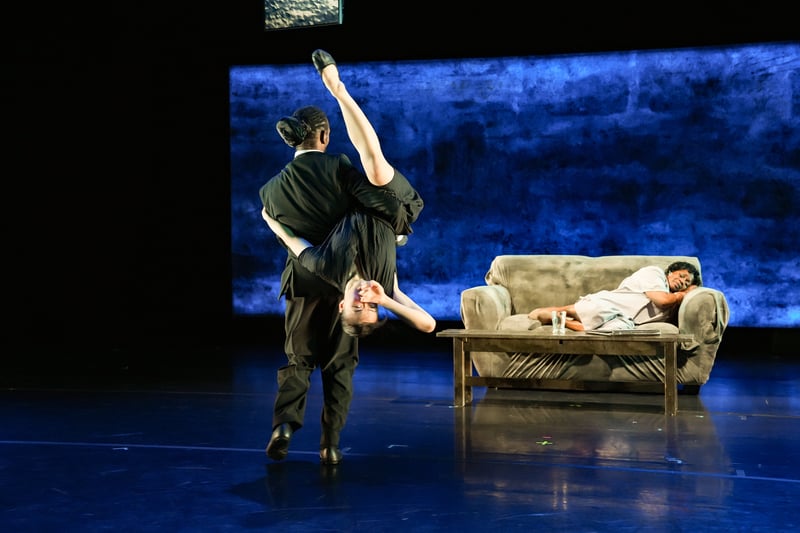
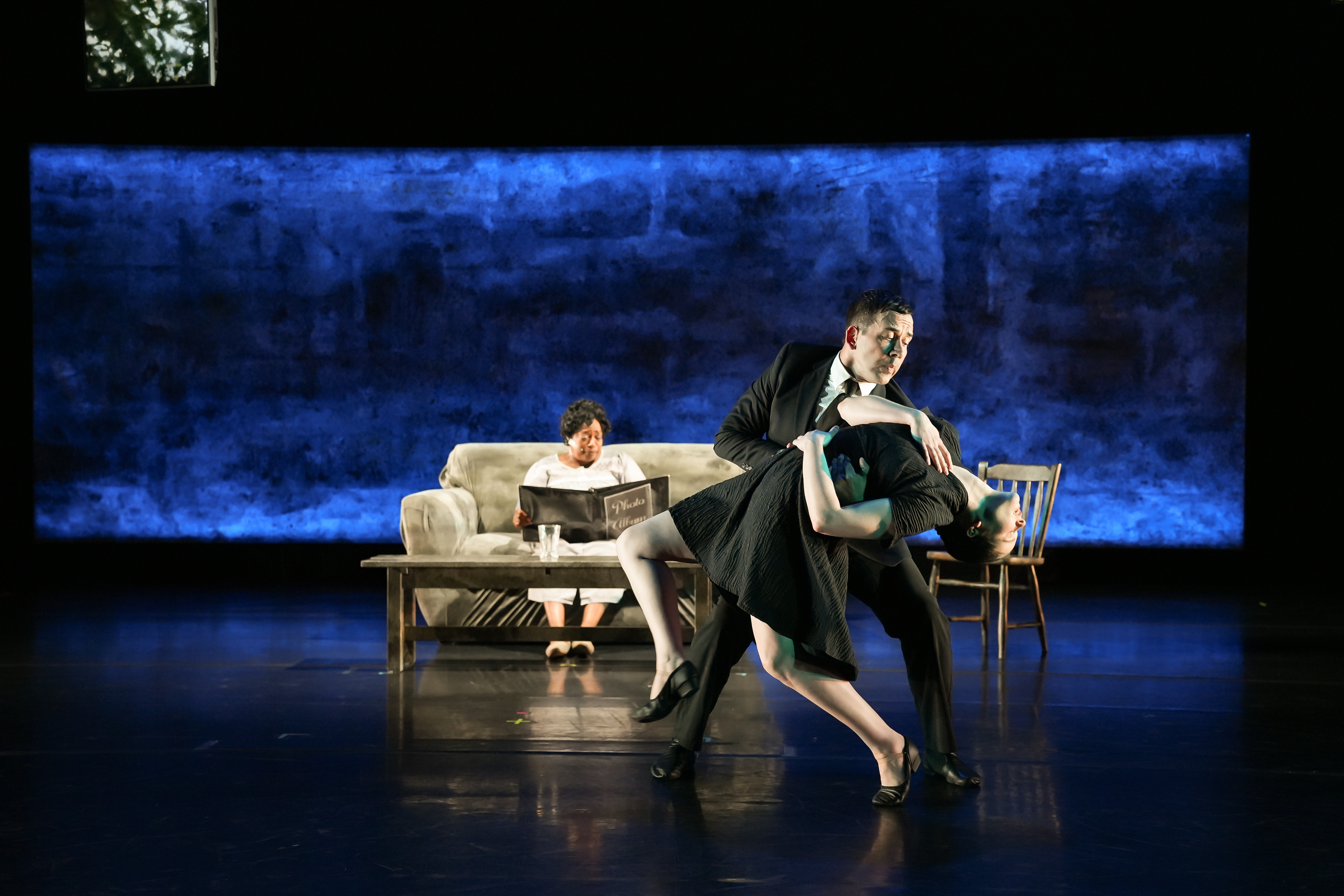
The third act, Grief, was based on the racially motivated murder of Emmett Till, a fourteen-year-old boy visiting his grandparents in the South. This act focused on the grief his family and community faced in the aftermath. For most of the act, Till’s mother, Mamie Till, sits crying on a couch, grieving for the loss of Emmett with her community. Community members dressed in black funeral wear repeatedly stumble to the ground crying, and rely on the support of others to stay up. The support the community gives each other shows the need for community in the wake of tragedies. Towards the end, the focus shifts from Mamie Till to the community, as women from the ensemble sob and shriek “Why?” at the front of the stage, conveying the extent to which the whole community was grieved. Although this act got a bit repetitive, it had a deep emotional impact through displaying the aftermath of a lynching.
This show was a difficult experience, but a necessary one. The nation’s legacy of racism is something many are scared to confront, but doing so is necessary to move forward. The three acts progress through time, and yet racist violence remains a constant, which the show explores. Byrd’s use of performance to show the development of racist violence brings an emotional impact that books and lectures struggle to. These emotions build understanding; both of the victims, such as the couple of the first act, the perpetrators, such as “Him”, and those affected, such as Mamie Till. Understanding the emotional impact of discrimination is the first step to righting historical wrongs.
Lead photo: Insidious Trilogy at Spectrum Dance Theatre. Photo by Alabastro Photography.
The TeenTix Newsroom is a group of teen writers led by the Teen Editorial Staff. The Teen Editorial Staff is made up of 5 teens who curate the review portion of the TeenTix blog. For each review, Newsroom writers work individually with a teen editor to polish their writing for publication.
The TeenTix Press Corps promotes critical thinking, communication, and information literacy through criticism and journalism practice for teens. For more information about the Press Corps program see HERE.