Slicing into "Fat Ham"
Review of Fat Ham, a Digital Production by the Wilma Theater
Written by Anna H. during an Arts Criticism workshop at Evergreen High School
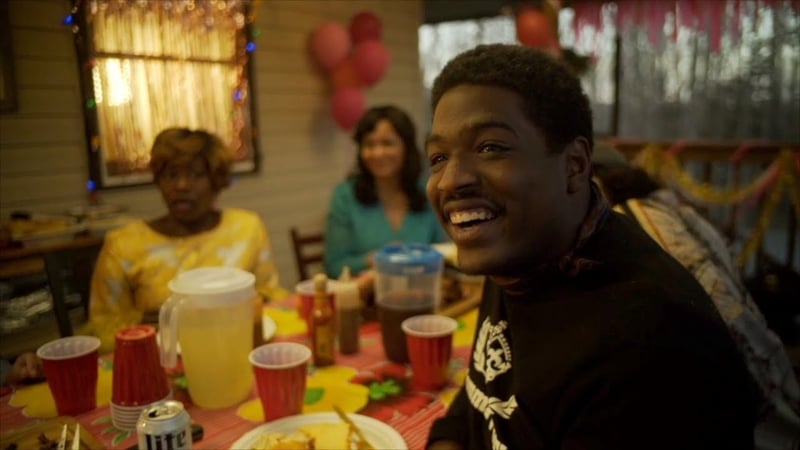
As you draw your knife towards the ham, you’ll not only find the oozing and fatty juice, but the intricate flavors that are a new take on politics, and breaking free from cycles.
The comedy packed play by James Ijames takes a spin on Shakespeare's tragic story, Hamlet. With chatter in the air and smell of grilled meat, we’re introduced to a modern day Black American family. We follow the family around as a spectator as the main character navigates through the death of his late Father. Fat Ham plays with the different stances of breaking stereotypes from intergenerational trauma and Black heritage.
Fat Ham takes Shakespeare’s Hamlet and weaves in rowdy Southern Black cookouts, and sets it ablaze in the best way. Entering our lead, Juicy, who is a soft hearted, philosophy quoting, and thicc young man who takes human resources classes online. He’s the type of guy who would rather hang around his cousins and his best friend Tio rather than deal with his family’s drama, but the drama finds him anyways. This act of taking online classes seems to stir even his late father’s ghost Pap up from the grave to nag our protagonist. What follows is an amusing and surprisingly tender rebellious story about a young queer Black man.
From the first five minutes of the showing of Fat Ham, it felt like taking a dip into new waters. It was a fresh and entertaining take on Hamlet compared to other adaptations trying to convey the same story. Fat Ham incorporated concepts of the classic tragedy with a game of charades, karaoke and a hallucinatory monologue about a gingerbread man brought to life by Tio. “In his dream, he says, he’s been pleasured by a gingerbread man, even though he usually prefers ‘gingerbread ladies’” (Tio to Juicy). Some may argue that there are barely any parallels in the play of Fat Ham and that the play is aimless, but this monologue explores the idea of being trapped into social norms, this can be tied back to how the character Hamlet from Hamlet is trapped from his own tragedy. Tio’s speech is about breaking free from expectations and choosing a path that's meant for your own.
The play challenges the cycle of violence and toxic masculinity. Tio directly speaks of the concept of “inherited trauma” when talking to juicy about the cycle of violence in their families he links this to the history of slavery. “Like your pops went to jail, his pop went to jail, his pop went to jail his pop went to jail,and what's before that? Huh? Slavery. It's inherited trauma. You carry around your whole family’s trauma, man” (Tio to Juicy). The play also critiques violence, homophobia, and manhood by showing how they harm both the person embodying them and the people around them such as Pap’s rejection of Juicy’s “softness”: “Pap took the doll I loved so much and threw it in the fire.” Through years and years of oppression it has become the norm to become the oppressor themselves. We can see this in most of the parents throughout Fat Ham including how Rabby expects her children to fall in line with her expectations, Rev refusing the help of Juicy just because he’s queer, and Pap refusing to feed into what he calls Juicy’s “softness”. It harms everyone in the end, but Fat Ham shows that even if there are roadblocks you can still make a change within yourself and those around you.
This play isn’t just for the laughs and critiquing dynamics, the play poses as a bold statement on identity. Pap and Rev follow a belief that a powerful man in a world that is designed to destroy you means that you have to be indestructible, violent, and in control. This ideology is a trap. It’s what leads to Pap’s murder and Rev's choking. Juicy’s softness, which was seen as a weakness by both Pap and Rev, is his primary resistance to their ideology. While speaking with Opal, she explicitly says, “what he thinks is your weakness gonna save you, Juicy.” She introduces the idea of refusing the path of violence that came before him and instead chooses to talk, feel, and love. The patriarchal model is a web of pain and oppression; Juicy’s queerness is what allows him to see outside of the model and break from traditional bloodline.
Fat Ham takes a detour away from the violence and death-ridden ending of Hamlet and it instead ends in a non-violent dance party finale. The play actively refuses to glamorize Black death and instead celebrates a new beginning after the end. The play’s politics are a rejection of pessimism and an embrace of hope. It brings light to the cycles of violence, racism, and homophobia. It allows for a different ending of joy, connection and a cookout instead of a bloodbath. Just because it's a tragedy, it doesn’t mean it has to follow through with it. This is a ham that I'll never forget, one that ends with hope rather than clashing blades.
Lead photo courtesy of Wilma Theatre.
The TeenTix Press Corps promotes critical thinking, communication, and information literacy through criticism and journalism practice for teens. For more information about the Press Corps program see HERE.
This review was written as part of an Arts Criticism unit at Evergreen High School in Emily Acquino’s Language Arts classes. Press Corps residencies are made possible by a grant from 4Culture.