
Art That Transcends Time: “Water Carries the Stories of Our Stars”
Review of Water Carries the Stories of Our Stars at the Frye Art Museum
Written by TeenTix Newsroom Writer YESSICA OSORIO DURAN
Edited by Teen Editorial Staff Member MARIELA VIDELA

As I stood in Priscilla Dobler Dzul’s exhibition “Water Carries the Stories of Our Stars” at the Frye Art Museum, a memory rose to my mind: “I don’t want to do this anymore. I’m going to watch TV instead,” I said as I abandoned my cloth napkin, with a few threads poorly placed in an effort to form a flower. Sitting beside me, my grandmother only laughed as she adjusted her needle and re-pierced the delicate fabric, decorating her napkin with strands of vibrant blue and neon pink. With no thimble, her calloused hands worked for hours to create the intricately designed napkins, which would hold the fresh tortillas we ate with every meal. Bright flower bouquets and groups of butterflies adorned her napkin by the end, while I was never able to finish a single napkin. Embroidery is one of many fading practices that have fallen victim to the passage of time–something that Dobler Dzul uses art to actively fight against.
In “Water Carries the Stories of Our Stars”, Dobler Dzul presents the viewer with stunning multi-media pieces that bridge the gap between time, nature, and humans, all while telling the story of water loss and environmental injustice that has persisted for generations. Dobler Dzul is an artist from Yucatan, Mexico, and Tacoma, Washington, who uses passed-down techniques to create art that shares her experiences and struggles as a cultural activist. Retaining cultural knowledge is difficult for those who are multicultural, as they are commonly left feeling as if they are “neither from here nor from there”. However, Dobler Dzul manages to maintain a deep connection to her Maya roots. Concentrating on the exploitation of living waters, Dobler Dzul’s art educates the viewer on the abuse faced by both the Maya people and land, while calling attention to the environmental discrimination and ecological crises occurring in both Yucatan and Tacoma. Her work is not limited to a place or style, as she presents the viewer with pieces made from various art mediums, including handblown glass vessels, ceramic sculptures, fiber art, and backstrap weaving, all executed in a way that honors traditional Maya culture.
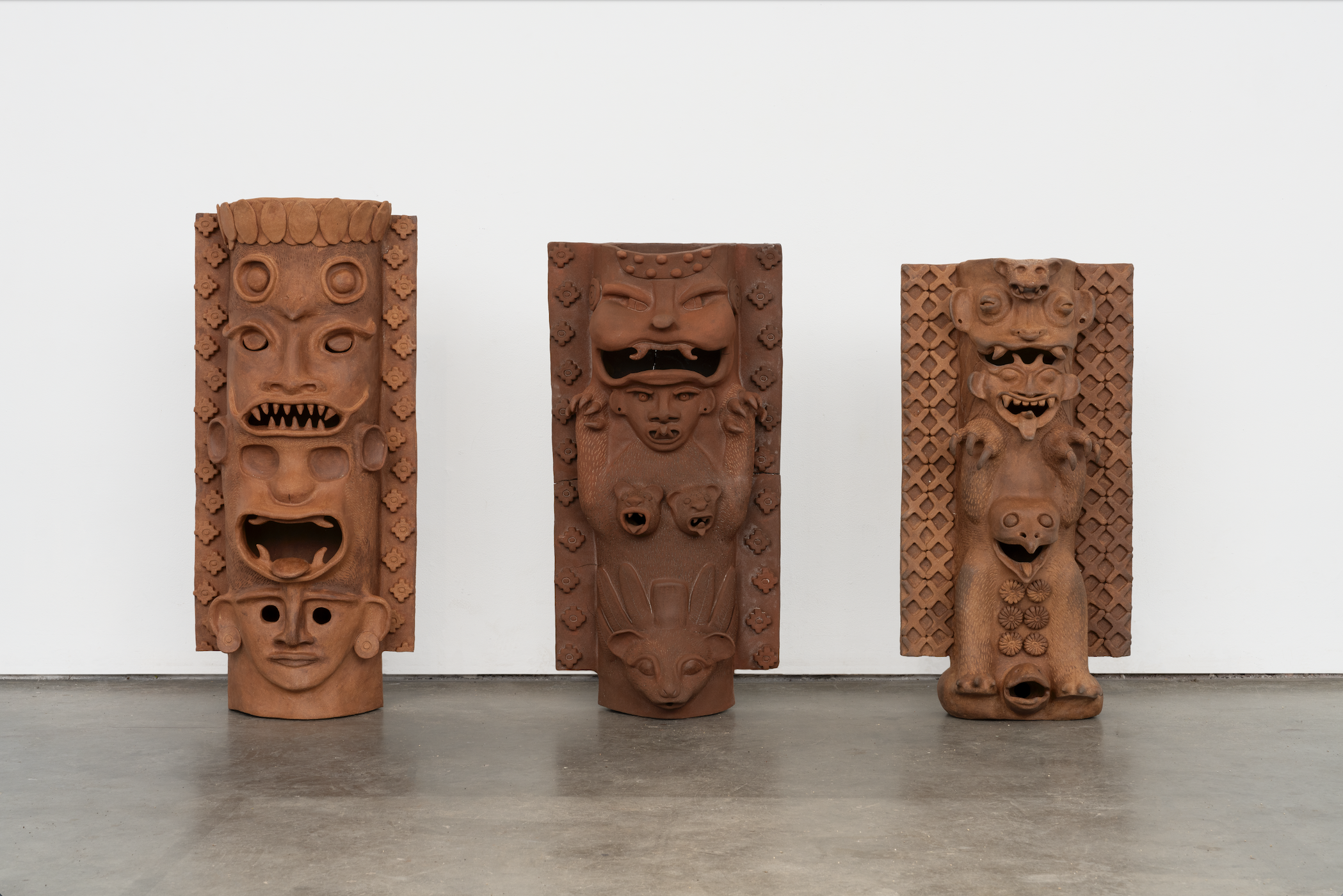
Inspired by ancient Maya protectors, “The Guardians Remind Us of What We Have Forgotten” is a collection of four clay sculptures in the exhibition, positioned in a row on a slightly elevated white platform. Each figure is a mixture of different animals: the antlers of a deer, the claws of a wild cat, the beak of a vulture–all things familiar to viewers but combined in a way that makes them seem mightier. In Maya culture, certain animals are regarded as guardians of the land and its people. Dobler Dzul has taken the traditional idea of these guardians and created new ones. Blending ancient culture with modern context, she calls on these age-old creatures to protect current waters and lands as they are threatened by environmentally disastrous projects like Mexico’s Tren Maya: a train nearly 1,000 miles long that traverses through five states in southeastern Mexico. The train has caused major deforestation in protected areas, destroyed cave ecosystems, and forced many local communities to relocate. Similarly, in Tacoma, Washington, underground water sources have been contaminated due to continuous industrialization. Dobler Dzul has created art that spans centuries, looking both into the past and into the future.

Courtesy of the artist. Photo: AJ Lenzi
One of the most eye-catching pieces in the exhibition is “And the Current Will Always Flow and Tell the Story,” a textile that uses embroidery and traditional materials found in Maya lands to illustrate the battle of modern technology and indigenous cultures. Featuring imagery like Boston Dynamics’ “BigDog” (a four-legged robot dog designed in 2005 for military use), surveillance cameras, and bodies lying on the ground, the piece illustrates the massacre of indigenous people and the destruction of land caused by this technology. The textile was made using henequen, a fiber indigenous to the state of Yucatan that the Maya people have been using for centuries. When demand for henequen rose, Maya people were enslaved and exploited for their labor. Dobler Dzul’s family has a history of enslavement, which is the reason why she chose to use henequen and other traditional materials in her art. By using historically significant materials and practicing Maya techniques, Dobler Dzul is preserving these traditions while using embroidery as a form of cultural resistance.
As I viewed the exhibition, I captured a few pictures for my mom. Once home, I began explaining the processes that Dobler Dzul uses to create her pieces, from the detailed movements of embroidery to the time-consuming motions of sculpting–many techniques passed down from Maya elders. Slowly, the conversation shifted as my mother began recalling stories of her grandparents and great-grandparents, of the dialects they spoke and the knowledge they possessed. Stories of people forced out of their homes, people whose traditions were lost, people who died before they could pass on the precious information they held. After speaking with my mom, I was able to truly see the themes of cultural revival and family history in Dobler Dzul’s art within my family and myself.
“Water Carries the Stories of Our Stars” is immensely powerful in the conversations it sparks, whether they center around Maya history, environmental injustice, or traditions lost to time. Through Dobler Dzul's unique storytelling methods, viewers gain a deeper understanding of cultural identity and the urgent ecological crises occurring in the lands we call home.
Lead photo: Priscilla Dobler Dzul. Aquí está el comienzo, en las tierras de los mayas / Here is the beginning, in the lands of the Mayas (detail), 2025. Jute fiber, cotton thread, western red cedar wood, natural pigments. 48 x 115 in. Courtesy of the artist. Photo: Mel Carter
The TeenTix Newsroom is a group of teen writers led by the Teen Editorial Staff. The Teen Editorial Staff is made up of 5 teens who curate the review portion of the TeenTix blog. For each review, Newsroom writers work individually with a teen editor to polish their writing for publication.
The TeenTix Press Corps promotes critical thinking, communication, and information literacy through criticism and journalism practice for teens. For more information about the Press Corps program see HERE.

