
Love at First Sight: PNB’s "Roméo et Juliette"
Review of Roméo et Juliette at Pacific Northwest Ballet
Written by TeenTix Newsroom writer MARIELA VIDELA and edited by Teen Editorial Staff member SYLVIE JARMAN

Imagine a performance of Romeo and Juliet without words. Could the tale possibly be as beautiful, as heartbreaking, without Shakespeare’s mastery of language? The answer is yes. Pacific Northwest Ballet’s production of Roméo et Juliette uses the language of dance to convey all the personality and emotion of Shakespeare’s classic play through a medium that is perhaps more moving than words: the body.
Set to Sergei Prokofiev’s wonderfully dramatic score, the tale unfolds over three acts through a blend of contemporary dance and classical ballet, choreographed by Jean-Christophe Maillot in 1996. Maillot’s choreography, combined with a stark, minimalist aesthetic, pulls all focus towards the dancers’ movements. Without the distraction of frills or intricate sets, the skill and expressiveness behind each gesture truly shines. The dancers spun in simple, neutral-toned costumes, designed by Jérôme Kaplan, against the background of large, white, geometric shapes that make up Ernest Pignon-Ernest’s spare scenic design. The Montagues wore lighter colors, and the Capulets mostly wore darker colors, distinguishing the two families. Although Juliet wore several ethereal dresses of shimmering gold and silver, it was clear that neither the costumes nor sets were stars in the show—all the glory went to the dancing itself. The modern, pared-down aesthetic made the production feel more mature than PNB’s recent extravagant, glittery productions like The Sleeping Beauty.
I appreciated how the contemporary twist to the dancing allowed the dancers to express emotion more vividly, more evocatively, than purely classical ballet would permit. During confrontations between the Capulets and Montagues, the choreography was sharp and exciting, filled with leaps and spins. Whereas during Romeo and Juliet’s encounters, it became tender and intimate, with delicate hand gestures and gently swirling lifts. Lucien Postlewaite was endearingly charming and lovestruck as Romeo, and Clara Ruf Maldonado brought a graceful lightness to Juliet. The choreography particularly emphasized hand gestures, with the two lovers pressing their palms together in a pose repeated throughout the performance, creating a steepled shape that seemed to simultaneously represent duality and unity.
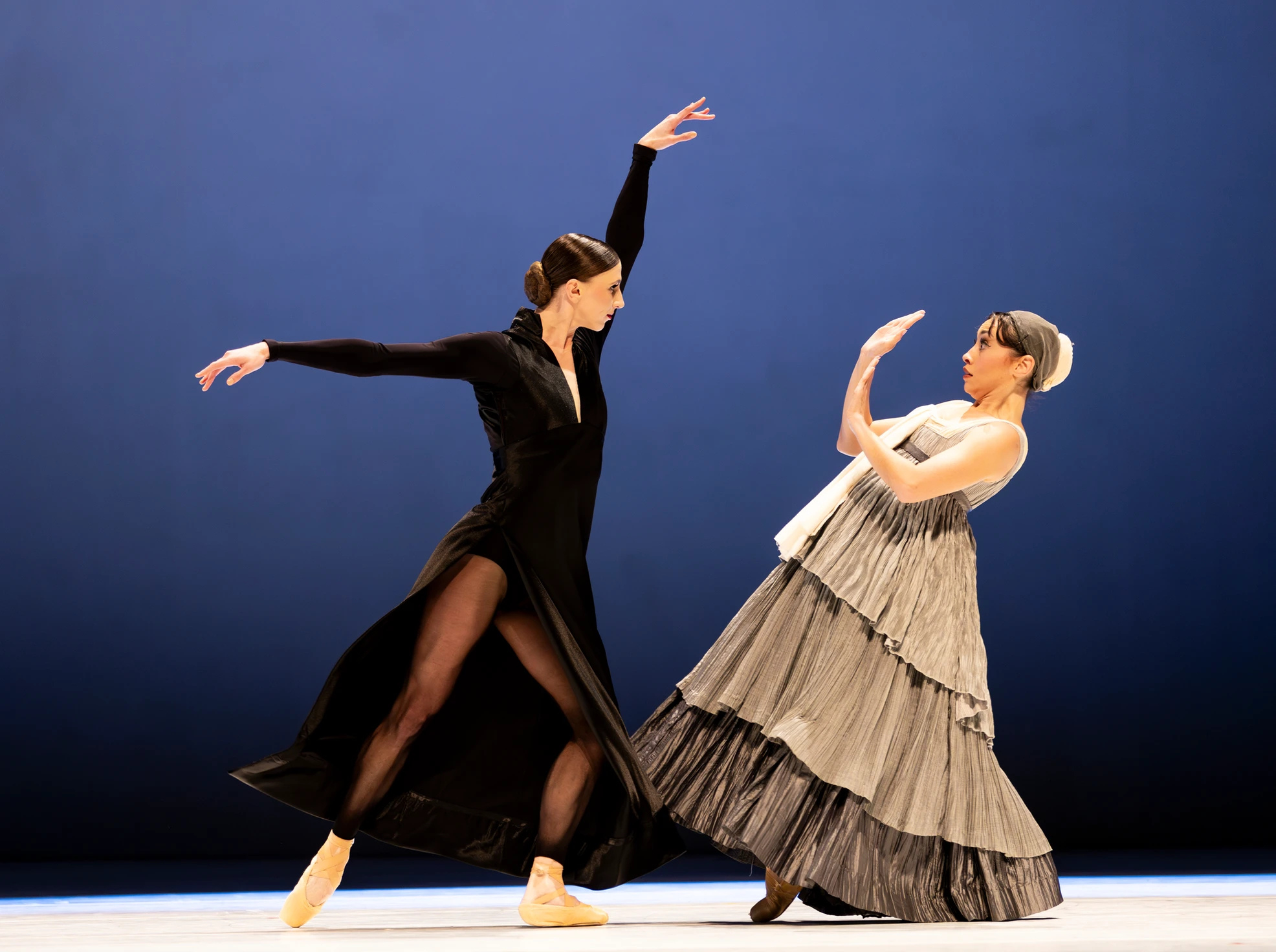
Sarah-Gabrielle Ryan as the Nurse, in Jean-Christophe Maillot’s Roméo et Juliette. Photo ©
Angela Sterling.
Small, sweet moments like this were what made it so moving to watch their relationship unfold. However, this consistent, gentle choreography softened the intensity of what could have been more breathless moments in their interactions, missing several opportunities for dramatic lifts. For this reason, the fight scene ending in Mercutio and Tybalt’s deaths was among my favorites. Fiercely animated, it allowed the male dancers to show off their strength with impressive lifts and soaring leaps. Jonothan Batista was excellent as a quick-tempered, swaggering Tybalt, and Kyle Davis was perfectly energetic and entertaining as Mercutio. Elle Macy stood out to me the most as Lady Capulet–her every sweeping movement stunningly expressive and commanding. I loved seeing how each dancer brought so much personality to their character, from Sarah-Gabrielle Ryan’s simpering, flustered Nurse to Christopher D’Ariano’s powerless, anguished Friar Laurence.
An unexpected choice was to center Friar Laurence as the narrator of the story. Several times during the performance, the dancers froze mid-dance, allowing him to narrate the events through a style that leaned more toward interpretive dance than ballet. The puppet show at the beginning of Act II was another interesting choice, playing out a comedic depiction of Romeo and Juliet’s entire ill-fated love affair. In a surprising twist, Friar Laurence and his acolytes are revealed as the puppeteers, making the audience keenly aware of how the young lovers’ fate has already been determined by forces beyond their control. Although the humorous little performance drew laughter from the audience, I was puzzled by how it fit into the rest of the story. For a ballet so focused on minimalism, it seemed like an unnecessary addition to the story.
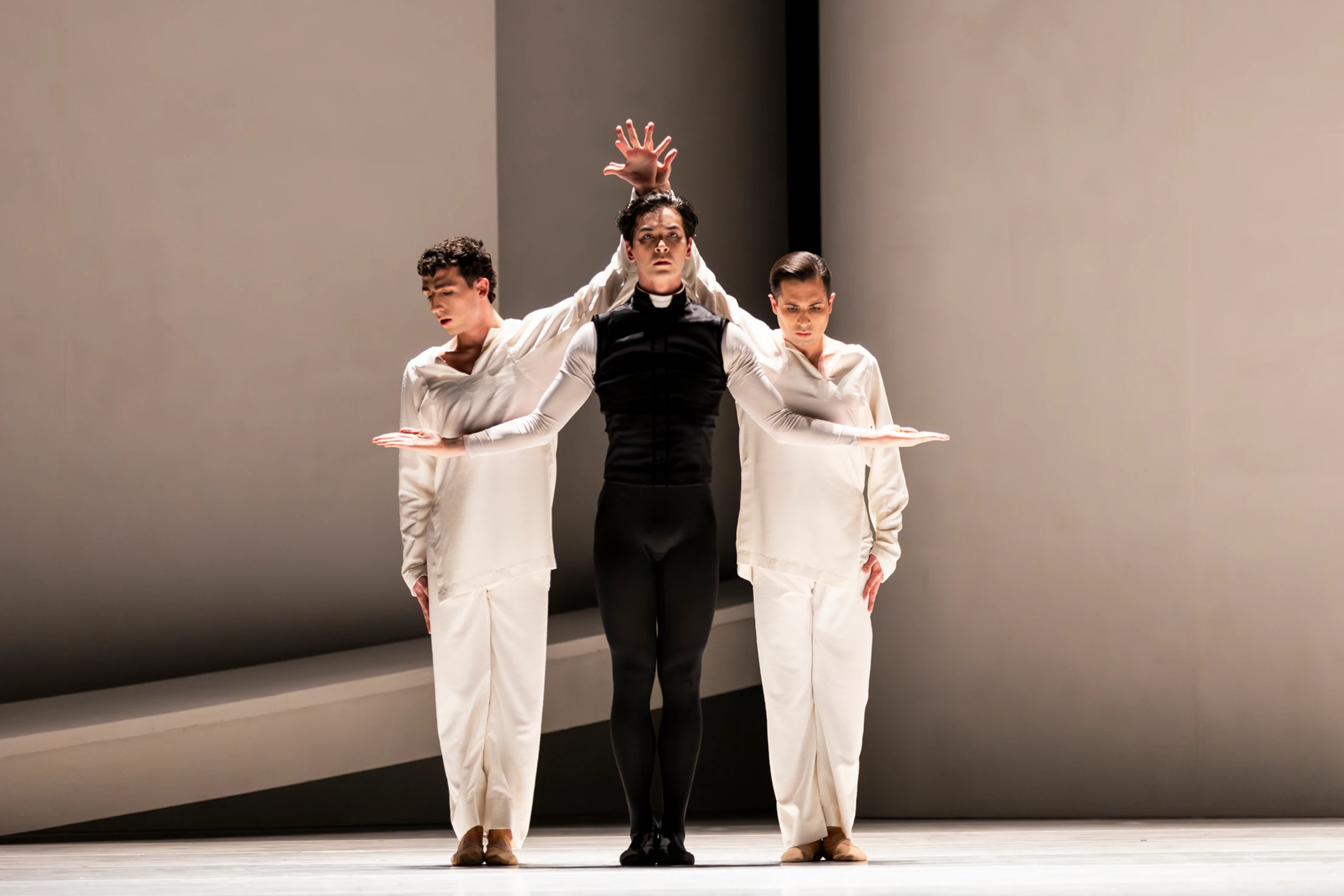
corps de ballet dancers Noah Martzall and Ryan Cardea, in Jean-Christophe Maillot’s Roméo et
Juliette, onstage at Seattle Center’s McCaw Hall April 11 – 20, 2025. (Streaming for digital
subscribers April 24 – 28.) For tickets and information, contact the PNB Box Office,
206.441.2424 or PNB.org. Photo © Angela Sterling.
Minimalism is what makes this production so powerful. By removing all distractions, it distills the emotion of Romeo and Juliet. The dancers feel more human, more real, when not shimmering in lavish costumes. Against a simple white background, their limbs become bold lines, their every movement filled with greater gravity. The stage seems to belong to them and the story they are telling. No time was this more apparent than in the final scene. Even the dancing itself fell away as Romeo stood still, gazing at Juliet’s sleeping form. The audience was allowed to sit with his anguish for several moments, to truly feel, instead of being blinded by lights and motion. Although the way Romeo died by flinging himself at the foot of Juliet’s bed seemed slightly theatrical, their last moments together and inevitable deaths were heart-achingly sad. I found myself hoping that both their love story and the ballet would go on. But Juliet’s horrified reaction of his lifeless body upon waking was swiftly followed by her graceful death, a scarlet ribbon wound around her throat. The emotional intensity of the ballet was palpable as the curtain lowered. Unlike most ballets I have attended, the audience did not clap between scenes. They were quiet and spellbound until the end, when they rose in a standing ovation.
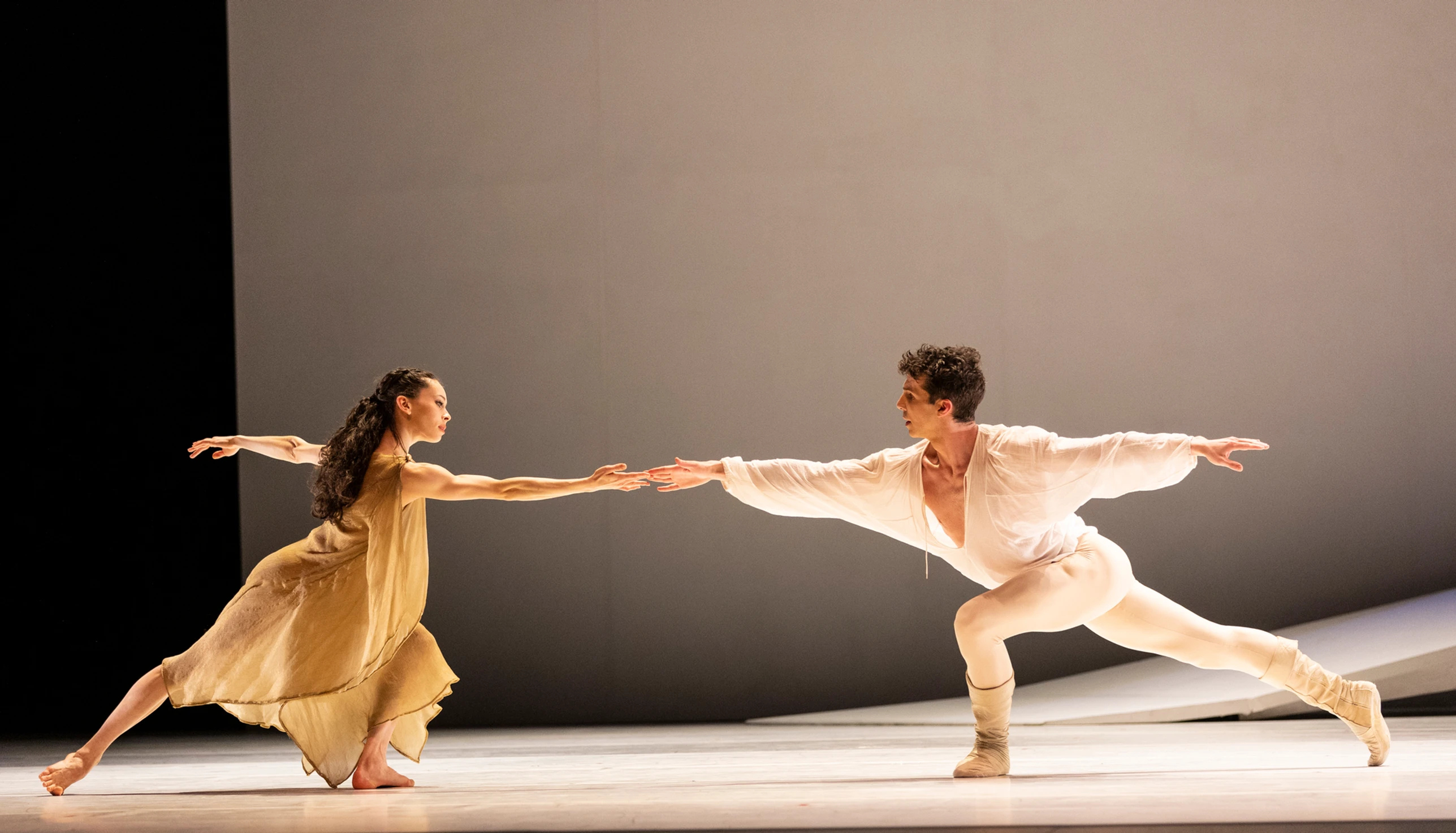
Postlewaite in Jean-Christophe Maillot’s Roméo et Juliette, Photo © Angela Sterling.
Much to my surprise, I found Roméo et Juliette a better display of dancing than PNB’s more elaborate productions. Beautiful sets and sparkling costumes, though a feast for the eyes, can distract from the art of the dancing itself. The beauty of Roméo et Juliette does not lie within the glamour and elegance usually associated with the ballet; it lies within the dancers’ incredible ability to tell a story with their bodies. By stripping away any ornate decorations and letting the dancers’ talent shine, PNB’s Roméo et Juliette conveys the powerful emotion of Shakespeare’s classic play without uttering a single word.
Lead photo: Pacific Northwest Ballet soloist Clara Ruf Maldonado and principal dancer Lucien
Postlewaite in Jean-Christophe Maillot’s Roméo et Juliette, Photo © Angela Sterling.
The TeenTix Newsroom is a group of teen writers led by the Teen Editorial Staff. For each review, Newsroom writers work individually with a teen editor to polish their writing for publication. Each month, writers are invited to pitch reviews to the editorial staff, expanding the scope of art covered on the TeenTix Blog - this article is one such pitch.
The TeenTix Press Corps promotes critical thinking, communication, and information literacy through criticism and journalism practice for teens. For more information about the Press Corps program see HERE.
