
What Is ‘What Is Perverse Is Liquid’: The Different Installations of A.K. Burns
Review of What Is Perverse Is Liquid at The Henry
Written by TeenTix Newsroom Writer MILO MILLER and edited by Teen Editorial Staff member SYLVIE JARMAN

A.K. Burns’ transfeminist art and interdisciplinary work come to the forefront in their new exhibit at the Henry Art Gallery, What is Perverse is Liquid. The exhibit depicts environmental damage in a manner that is moody and ominous, but Burns’ straightforward message and knack for keeping their distinct work interesting throughout creates a mesmerizing gallery experience, even if the exhibit as a whole struggles to gel.
Of the many striking pieces of What is Perverse is Liquid, the first is a duology, untitled (grain) and before the wake, both detailing careless environmental destruction in different ways. untitled (grain) sees Burns shooting the Utah desert on expired film, creating the eerie image of an alien planet and proving that expired film is not really “expired” until we say it is. before the wake, its companion across the hall, continues the theme of damage by staining, warping, and ripping 1950s magazine photos of the Glen Canyon in Utah. Burns presents a straightforward thesis here: if we do not make it better, the environment will become just as damaged as these papers. It will turn into the frightening alien world of untitled (grain). It’s grating, engrossing, and real—but most of all, it’s easy to wrap your mind around. The best of Burns’ art isn’t the complex, or the mystifying. It’s the clearly focused projects that stand out from the rest.
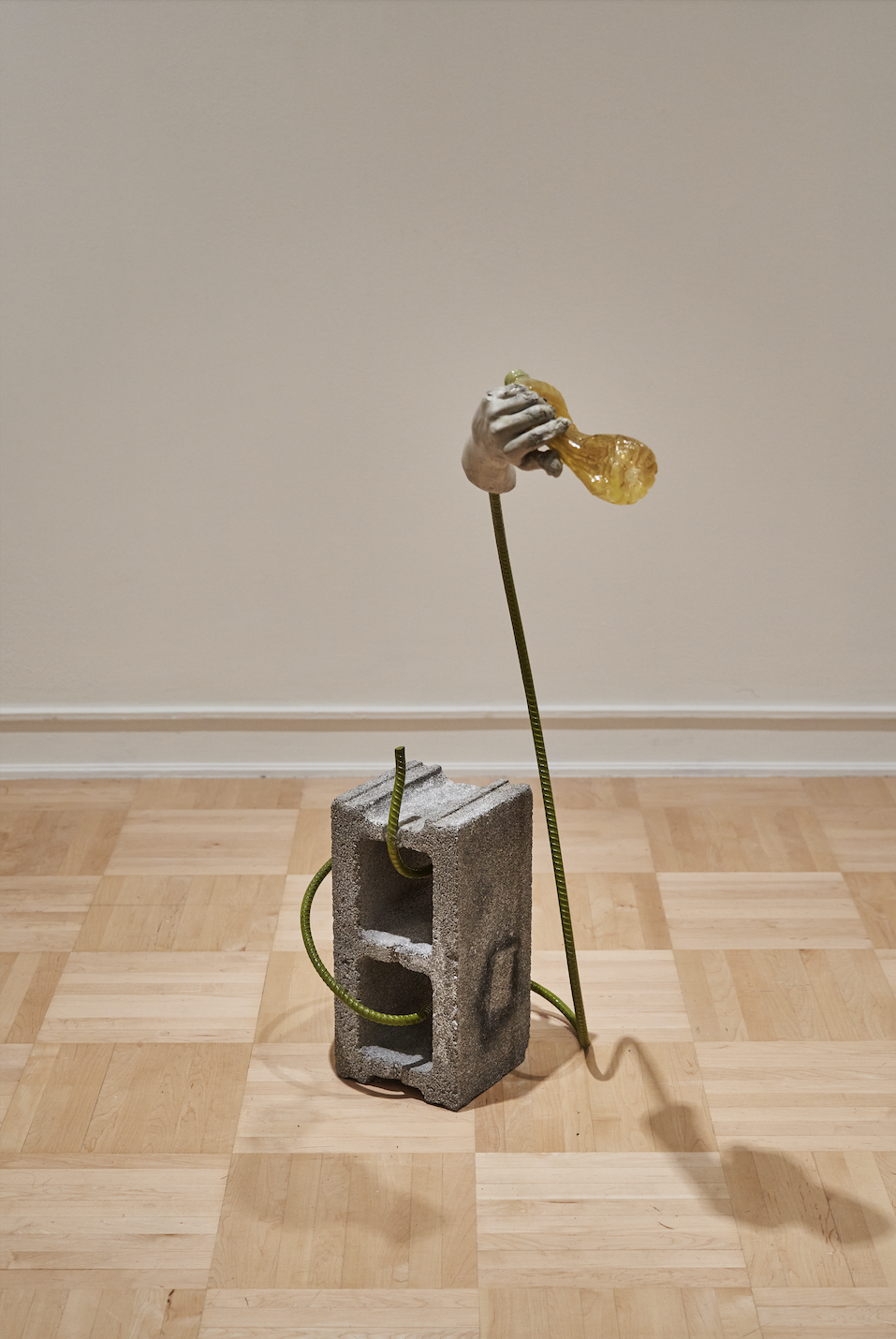
Throughout, Burns’ physical work is clearly indicative of the human body and its environment. Humanoid sculptures made from metal wiring complement this, as do their silver nitrate-infused Disturbed Mirrors, one of which interrupts every room less so with a mystic reflection but its own warped qualities. These expressions of Burns’ ecological interpretations are dark. They are almost always twisted, uneasy portraits of human experience in and around the world that invoke the ideas of damage and hurt. Those two pieces put together make up the “feel” of the physical work of Burns. The literal stuff never steps too far into the uncanny valley or the real world so as to protect its air of mystique, and the abstract stuff never veers too far off the rails from the meat and message of it all.
It’s a nice break from the videos, too.
That very video work, however, is far different, and far more cryptic. The largest room in the exhibit is an expansive black space centered by a cube, sat at a slight diagonal in the middle. Burns’ films are projected onto each side of the cube; credits are hidden on the top side. Visitors sit against the walls to watch. Their neighbors are piles of tires, which sets an industrial tone for the film. Among the many short films Burns projects onto the cube are: a hazmat suited-man in a glowing purple room vacuuming smoke; ‘80s video game-esque graphics giving way to an isolated arch of speakers; and a group of mystery, partially-clothed desert-goers arrange dilapidated furniture and building materials into the perfect position.
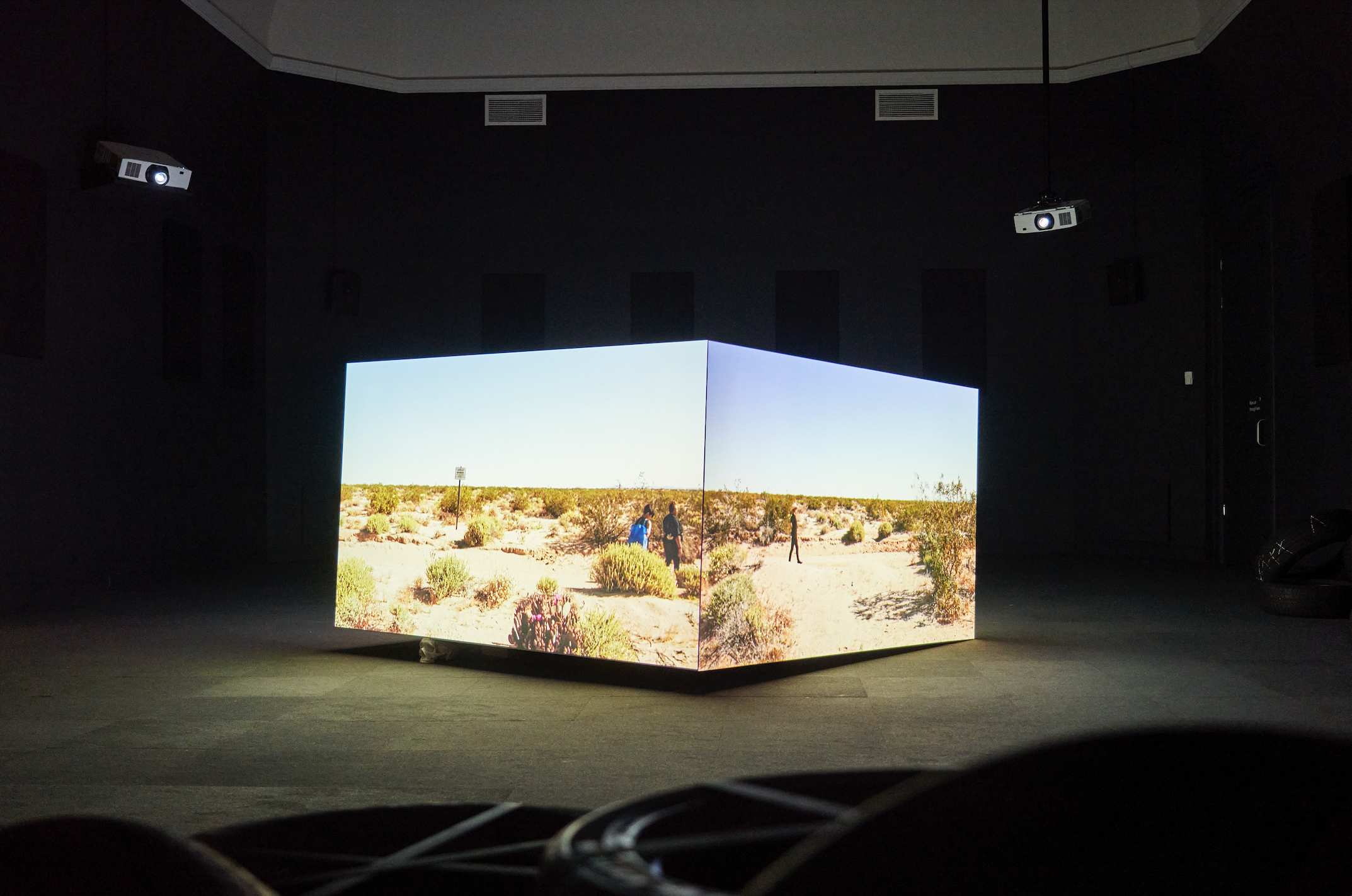
These films conjure that eerie perspective of people in weird spaces doing weird things. In a more meta sense, it’s just like us: sitting in a gaping dark room, surrounded by tires, watching these strange films on a lopsided cube. It’s another kind of mirror from Disturbed Mirrors, but it still reflects the visit back upon themselves. If A.K. Burns wanted to translate their fears of acceptance and environmental sustainability into an almost tangible feeling—which they most certainly did—then with this sensation alone they have hit it out of the park.
There’s one more room in the exhibit, and it’s almost hidden. If the only purpose this review serves is to alert people of its presence, and it will have been enough; the door to the final room sits on the far end of the black video-cube room, and seems like an employees-only door until closer inspection reveals a sign that promises “more art behind this door.” Indeed, another triptych video installation completes Burns’ vision by simply juxtaposing the distinct monotones of office life and nature. It’s strikingly straightforward, like Burns’ best work (i.e., the vinyl record greeting visitors with an invitation to play it, or the exhibit’s final room, which contains perhaps the strangest industrial disco music video ever made). These pieces have very little flow when put together, but they’re great. They’ve all got that touch of signature Burns surrealism in places you’d never expect to find it: in the center of one video screen triptych sits a pool of sand, walled by sandbags, in which pennies have been sprinkled to evoke a wishing well.
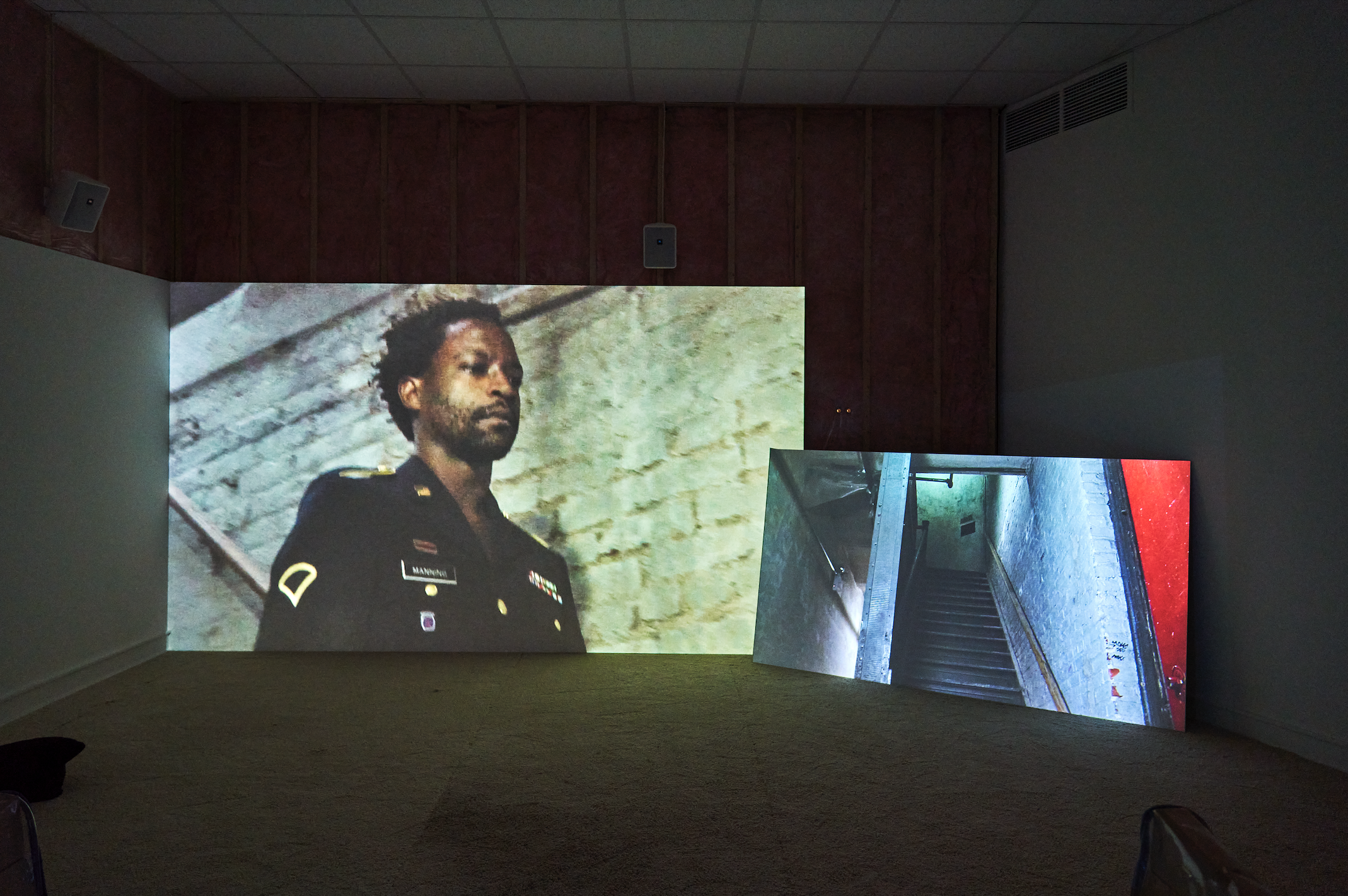
Wishing for what? Maybe for the exhibit to be more cohesive. Above the mysterious vinyl record, a grandiose stone archway sets the tone—but this majesty shifts to the sleek modernism found in their video installations. The mirrors, the humanoid sculptures, and the curious shirts reading “Witness Protection Program” worn by multiple characters, all serve as pleasant motifs, but their sparsity leaves only the idea that Burns could have used their tactfulness to connect these ideas. Too many of these recurring figures are offset by totally random objects, like the wishing well itself. If the exhibit had a more concise sense of elements that added to each other and the larger picture, viewers would be more able to appreciate it. This becomes most noticeable on one’s way out of the exhibit; after a dead end, patrons must take a U-turn and go back the way they came. This is the perfect way for the themes of Burns’ pieces to be appreciated, twice through—once with a sense of mystery and once with a sense of curiosity—and if only Burns took complete advantage of this opportunity to perpetuate those feelings, the exhibit would feel complete.
Burns’ art is all-encompassing. Even if it doesn’t share a tone throughout, the exhibit shares a theme. The environmentalist thought through the lens of people, their bodies, and their identities, is a powerful cause and Burns makes the most of it by creating fascinating art that is above all accessible, engaging, and intriguing. In making their audience curious, Burns succeeds in creating a phenomenal exhibit.
Lead photo by Jonathan Vanderweit.
The TeenTix Newsroom is a group of teen writers led by the Teen Editorial Staff. For each review, Newsroom writers work individually with a teen editor to polish their writing for publication. The Teen Editorial Staff is made up of 6 teens who curate the review portion of the TeenTix blog. More information about the Teen Editorial Staff can be found HERE.
The TeenTix Press Corps promotes critical thinking, communication, and information literacy through criticism and journalism practice for teens. For more information about the Press Corps program see HERE.
