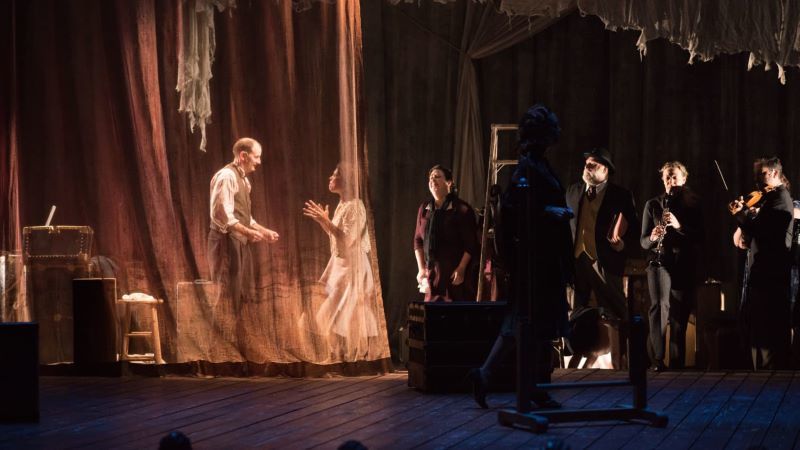
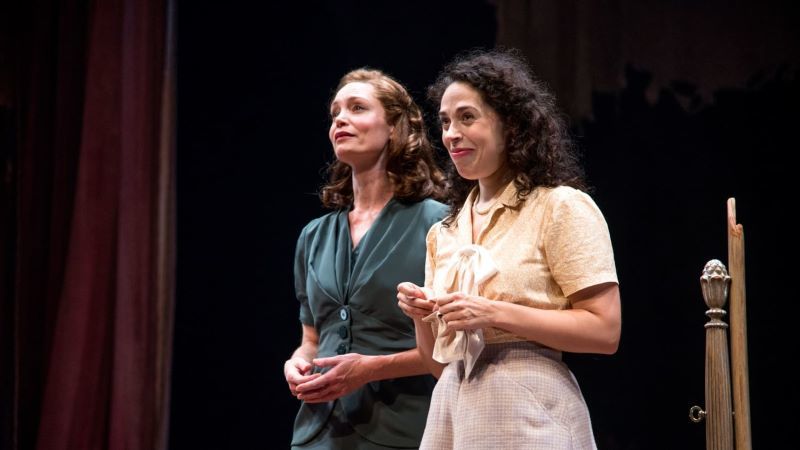
Halfway into the performance, there is a moment where the entire cast within Indecent reveal yellow Jewish stars on their clothes, and one person stands out against the crowd. One star is not just yellow, but a black triangle and a yellow triangle, put together to make the star. The black triangle was used to mark many things, one of those being the mark for lesbians. At first the addition of it was shocking to me, as the black triangle isn’t too often used as a queer symbol, but it rather became a nice addition in a play that concerns a queer Jewish story. Written by Paula Vogel, Indecent tells the story of the writing, producing, success, and censoring of the play God of Vengeance by Sholem Asch. God of Vengeance was the first performance on Broadway to feature a kiss between two Jewish women, one the daughter of a brothel owner and the other an ex-prostitute, which gets the cast of God of Vengeance arrested after their first performance on Broadway. While Indecent is not a queer story itself, the way it choses to explore how people intake queer theater, and how intersectionality plays into that, makes it an interesting and worthwhile play to see.
Within Indecent there are two ways in which the characters view God of Vengeance, one view is with disdain, the other is a love for something that dares to show what some may see as obscene within a beautiful light. The romance between the two female leads in God of Vengeance is brought up many times within Indecent, with one particular scene being mentioned above the rest, this is what is referred to as the rain scene. The rain scene is mentioned over and over, and it is most often described as beautiful, one of which that shows the most wonderful love between two characters who just so happen to be women; one character even compares this scene to the balcony scene from Shakespeare’s Romeo and Juliet. Within this, Indecent shows how queer media and theater can easily be normalized within the eyes of many, allowing some to see it simply as another love story. Meanwhile, there are others within the story that see the love between two women only as something wrong. Within the scene where Sholem Asch first shows God of Vengeance to others, he is met with a clear message: That the story of two Jewish women falling in love at a brothel is not what the world needed to see, especially of the Jewish population. This carries on into the opening night of God of Vengeance on Broadway, in which the one who reports the play to the police, which, in turn, gets the cast arrested, is himself a Jewish man. This man gets an entire monologue to explain his motives, about how he cannot understand why the Jewish author of the play would try to show something, seen by many at the time as obscene, as acceptable. Through God of Vengeance, Indecent shows how one’s ethnicity and religion affects how one views a form of media, especially queer theater.