Not Quite "The Best Damn Thing"
Review of The Best Damn Thing at Dacha Theatre
Written by TeenTix Newsroom Writer JOSEPH HWANG
Edited by Teen Editorial Staff Member CLARA THORSEN
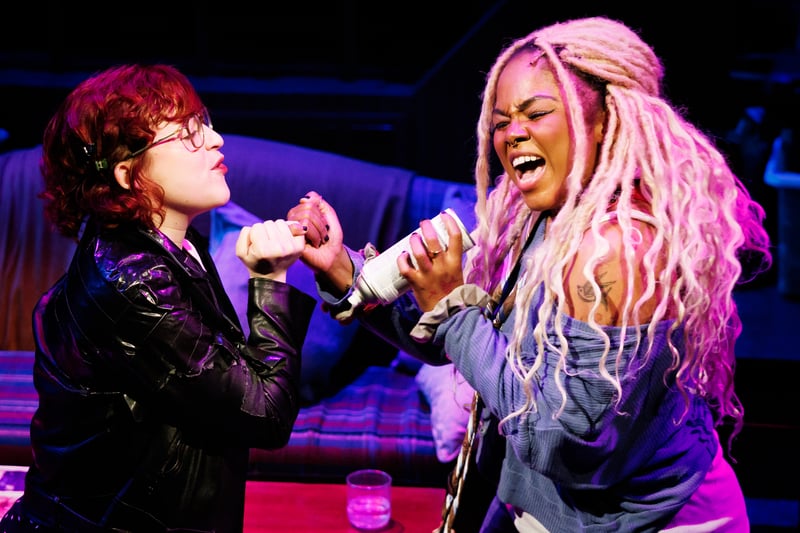
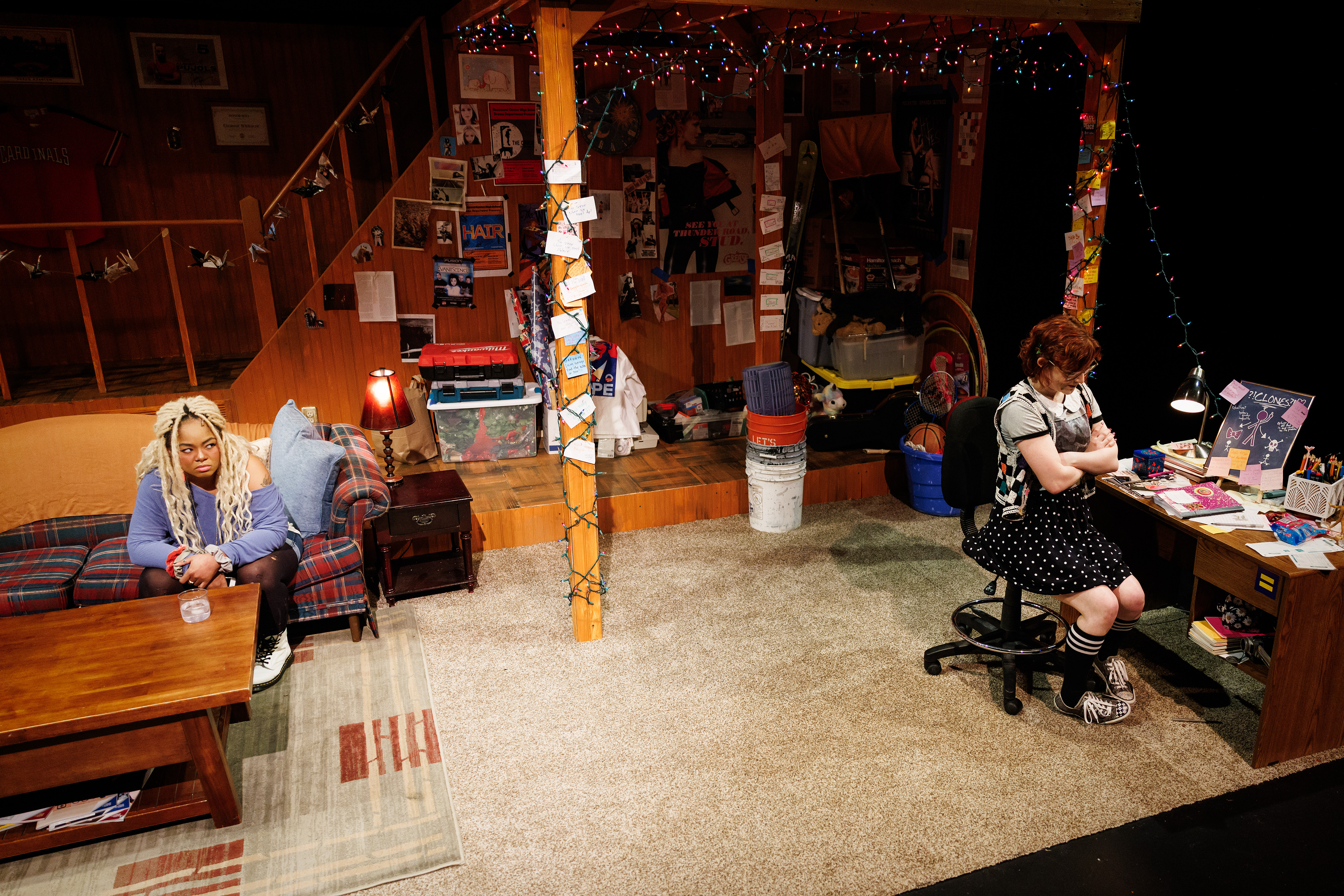
In 2002, Avril Lavigne spoke her truth: being ordinary is as good as being dead. The Best Damn Thing runs with that message, making its West Coast premiere at 12th Ave Arts just last month. Directed by Kate Drummond, the show follows Missouri teenager Ellie, who has written what she believes is the greatest Avril Lavigne jukebox musical ever conceived. But, she needs her former best friend Rachel to bring it to their school stage. The two-person cast and visually inventive set, designed by Jeremy Hollis, bring an electrifying energy that hooks the audience immediately. From the opening moment, the audience is drawn into Ellie’s room, a cluttered, almost overwhelming space where each object offers a glimpse into her life. However, in the show's attempt to be hyper-meta and its density of ideas, it ends up resembling its protagonist: overwhelmed by ideas, and ultimately unclear.
Before the show even begins, a friendly Dacha staff member hands out a set-themed I-Spy sheet, making it clear that The Best Damn Thing wants the audience to feel involved. The theater itself is tiny, with bleacher-style seating that puts you close enough to feel the anxiety radiating off Ellie. From the moment she steps onstage, Shannon Johnson brings a nervous, rapid-fire energy that captures Ellie’s desperate hopefulness. Moxxy Rogers plays Rachel with sharp contrast: dismissive and poised. When the two explode at each other in an emotional confrontation, both actors tap into something genuine. However, the script doesn’t measure up to the moment. The dialogue leans so heavily on profanity that the scene loses its edge; by mistaking noise for intensity, the cursing fails to convey the rawness of teenage anger.
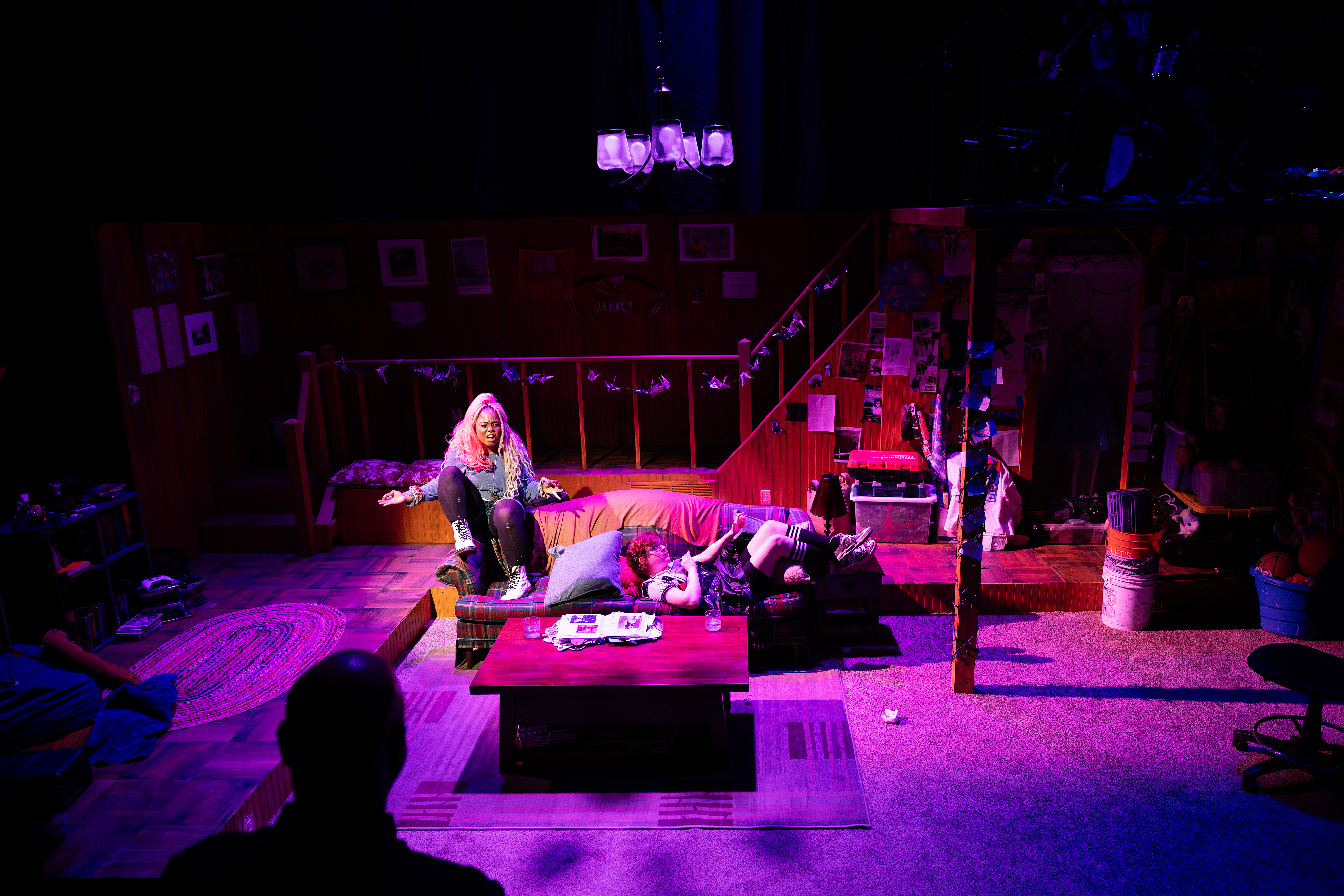
The production's design is one of the show’s greatest strengths. A live band perched on a visible platform above the stage gives the show constant energy, and Annie Liu's lighting brings clarity to a complicated, layered narrative: blue for "April," the character within the show’s storyline, purple for meta-character transitions, and warm yellow-white for real-world scenes. The ASL interpreters, dressed in black and positioned to the side of the stage, are expressive but unobtrusive. Their integration into the performance space, featured at select performances, along with the production's pay-what-you-can model and dedicated Gen A-Z nights, is a thoughtful approach to making art more accessible. It's an ambitious approach, and a visually compelling one.
But the show's ambition ultimately becomes one of its greatest liabilities. The Best Damn Thing is a musical about a girl pitching a musical, which then shows us scenes from that inner musical, which then comments on both. Even in theory, the idea is shaky. In practice, the story becomes exhausting. As characters shift between reality and the imagined show rapidly, the narrative is lost and the meta-message collapses. In theory, it’s a smart idea to have the inner story’s character reflect the two protagonists, but those same two actors are also tasked with playing a teacher, her husband, a classmate, her boyfriend, another student, and more. While the performances are commendable, the constant character pivots don’t give the audience room to breathe.
Over the course of 110 intermission-free minutes, The Best Damn Thing tries to address neurodivergence, friendship betrayal, sexism, gossip culture, impostor syndrome, a teacher-student rumor, parental pressure, bi-curiosity, idolization, and teen perfectionism. If the show had narrowed its scope, it would have a clear emotional throughline. Without a central theme, the story ultimately fails to resonate with the audience. That disconnect becomes clear when references to Susan Sontag and Mad Men drew laughs from some audience members, but fell flat with many teens in the room.
The music runs into a different issue because the show attempts to use its songs as satire of jukebox musicals. But even intentionally "bad" music has to be enjoyable to sit through, and too often the songs are grating because the show never fully commits between celebrating the music and making fun of it. Avril Lavigne is known as the pop-punk princess with a razor-sharp tone: angsty, rebellious, with just enough raw honesty to stick with a teenage audience. That tone clashes with the show’s attempts at irony, undercutting both the story and the music.
In its final sequence, as smoke pours across the stage, backlights blaze, and the set itself comes apart, The Best Damn Thing sets a thrilling image, capturing the show’s tension. The musical is bold, kinetic, and alive with possibility. But like Ellie's own musical, its desperation to be taken seriously ultimately overwhelms its clarity. In a show so determined to reject ordinariness, it forgets that sometimes, the simplest moments are the ones that stay with you. For all of its ambition, The Best Damn Thing is easier to admire than fully recommend.
Lead photo: Shannon Johnson and Moxxy Rogers in Dacha Theatre's The Best Damn Thing. Photo by Brett Love.
The TeenTix Newsroom is a group of teen writers led by the Teen Editorial Staff. The Teen Editorial Staff is made up of 5 teens who curate the review portion of the TeenTix blog. For each review, Newsroom writers work individually with a teen editor to polish their writing for publication.
The TeenTix Press Corps promotes critical thinking, communication, and information literacy through criticism and journalism practice for teens. For more information about the Press Corps program see HERE.